TL;DR:
- Mastodon is a decentralised, free and ad-free social network. It runs as a federation of autonomous instances that talk to one another, which gives control back to communities and to the people who publish.
- The feed is chronological and not manipulated by engagement algorithms. The result: less noise, fewer toxic posts pushed to the top, and often better mental comfort.
- Privacy: minimal collection, no advertising profiling. You can choose your instance, move elsewhere and keep your subscriptions, or self-host.
-
Quick comparisons
- X: centralised, ads, algorithms, enormous reach but more chaos. Mastodon is calmer, community-minded, ad-free, with local moderation.
- Facebook: all-in-one and intrusive on data. Mastodon is more sober, centred on public discussion, not a clone of groups and events.
- Bluesky: promises decentralisation but is still fairly centralised; it bets on customisable algorithmic feeds. Mastodon is more mature on federation and on community culture.
- Matrix: a complement for decentralised messaging and internal community management. Mastodon serves public communication instead.
- Limitations: a less intuitive start, slower discovery of accounts without algorithms, a smaller and more fragmented audience, distributed moderation that demands good instance choices, an interoperable but sometimes uneven ecosystem.
- Who it is for: communities, non-profits, schools, independent media, collectives and SMEs looking for sovereignty, security and a healthy setting.
- Quick tips: pick an instance aligned with your values, use hashtags and lists to discover people, turn on CWs when needed, and pair Mastodon for the public side with Matrix for internal organizing.
In this article
- Introduction: the dominant networks are centralised, and their model rests on collection.
- What is Mastodon?: the interface, column by column, and the "toot".
- The principle of decentralisation: no single server at the centre: the Fediverse is a network of interconnected nodes.
- Benefits for privacy, control and mental health: a concrete impact on wellbeing, not just abstract ethical arguments.
- Comparisons with X, Facebook and Bluesky: X, Facebook and Bluesky, each with its own approach.
- Challenges and limitations of Mastodon: the flattering picture should not hide the challenges.
- Conclusion: a renewed vision of social networks, built on decentralisation and ethics.
Introduction
Dominant social networks such as Facebook and X (formerly Twitter) are controlled by large centralised companies. Their business models rest on data collection and on algorithms that maximize user engagement – often at the expense of our wellbeing. These platforms decide what we see, exploit our personal information for advertising, and can even influence our emotions and our opinions (with the harmful consequences we know of for mental health and for the polarization of public debate). Against that backdrop, an alternative has gained ground: Mastodon, a decentralised social network, free software, ad-free and designed to give control back to its users. Aimed at the general public as much as at professionals and communities looking for an online space that is private, secure and ethical, Mastodon promises a different experience – one with more respect for personal data and for the psychology of the people using it.
In this article, we will look in depth at what Mastodon is and at how decentralised social networking works. We will compare it directly with X, Facebook and Bluesky, without technical jargon, so that its advantages (and its limits) against the conventional platforms come through clearly. We will also see how this approach draws interesting parallels with users' mental health and with the idea of controlling your own online experience.
What is Mastodon?
Screenshot of the Mastodon web interface (version 4.3.1). Each column shows one part of the service: on the left, the field for publishing a message (a "toot"); in the middle, the timeline; and on the right, the menu.

At first glance, Mastodon's interface looks like Twitter's: there is a feed of short messages (called toots, up to 500 characters) with the ability to reply, to republish (boost, the equivalent of a retweet) or to add to favourites. Mastodon, though, is not a single site owned by a company: it is a network of interconnected sites. In concrete terms it is made up of many autonomous community servers (called instances) that users sign up on. Each instance is run by an independent person or organization, sets its own rules, its language, its theme and so on, but they can all communicate with each other. A user on mastodon.social can follow and send messages to a user on piaille.fr or mamot.fr as if they were on the same network. That distributed architecture – what is called federation – sits at the heart of how Mastodon works, and of the whole "fediverse" (the ecosystem of federated social networks). Mastodon uses an open protocol for it (ActivityPub), also adopted by other compatible services (PeerTube for video or Pixelfed for photos, for instance), which allows interoperability between different platforms.
In practice, Mastodon works like a decentralised Twitter. The project was launched in 2016 by Eugen Rochko, a German developer who wanted to create a "democratic" social space funded by its community (through donations), with no advertising and no single owner. Long confined to a circle of insiders (often technically minded people already won over to free software), Mastodon really took off at the end of 2022 with Elon Musk's purchase of Twitter, which sent users fleeing towards the alternative: the service went from around 400,000 to more than 1.3 million active users in a few weeks. Growth has continued since: by December 2024 the estimate was roughly 10 million monthly active users spread across thousands of instances. That remains modest next to the giants (Twitter passed 300 million before its recent decline), but Mastodon is part of a deeper trend, offering another road, one centred on community and transparency.
The principle of decentralisation
The symbolic logo of the Fediverse (a community proposal). The five interconnected nodes illustrate a network with no single centre.
Decentralisation means that no central server controls the social network as a whole. Instead of a single platform (like Facebook or Twitter), Mastodon is spread across many independent but interconnected
nodes, hence the term
federated network.
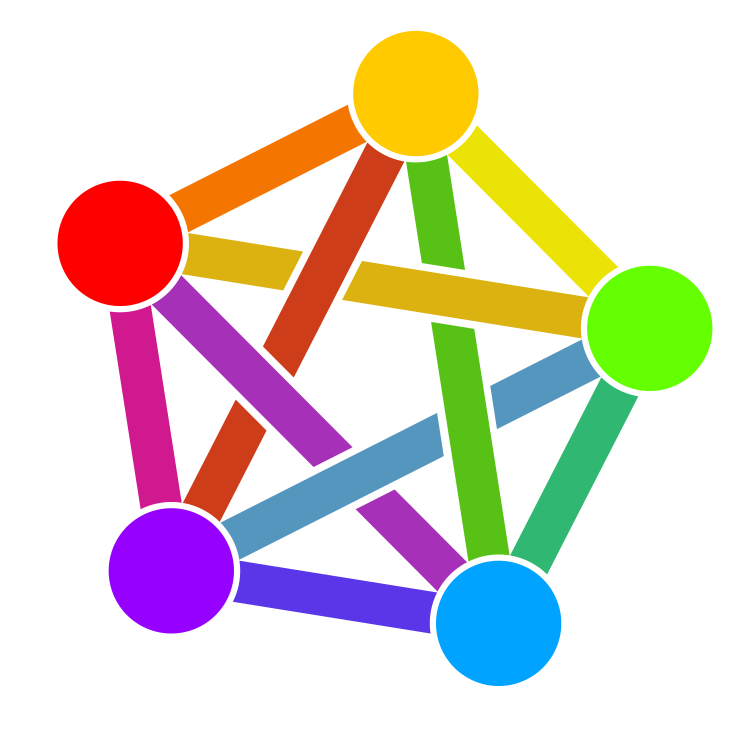
The diagram above captures the idea well: every node (a coloured dot) is connected to all the others, forming a collaborative mesh. In practice, that translates into a large number of Mastodon instances that you are free to join. Each instance works as an autonomous community: it has its owner and administrator, its own terms of use and its own local moderation policy. No single entity owns or runs Mastodon as a whole: power is spread between the volunteer administrators of each server and, in the end, between the users themselves.
That architecture brings several notable benefits:
- Individual and community control: decentralised networks "belong to the community of users, which decides what uses may take place there", as a report by Renaissance Numérique puts it. In practice, that means Mastodon users have a hand in many things: choosing a server according to their affinities (you can join a photography-oriented instance, a general-purpose French-language instance, an instance run by and for your own organization, and so on), the option of changing servers if you no longer agree with your community (without losing your subscriptions, thanks to account portability), and even the option of creating your own Mastodon instance and setting its rules yourself. At the scale of the whole network, no authority can arbitrarily impose a policy or censor every user: if a server becomes a problem, the others can choose to disconnect it (to de-federate it), but there is no central "red button" in the hands of a company or a government to cut Mastodon off. Every community is therefore free, within the law, to organize itself as it sees fit.
- Respect for privacy: on Mastodon, your personal data belongs to you. The platform does not ask for your real name, your phone number or other intrusive details in order to sign up; an email address is usually enough. Because the software is open source and the ecosystem is spread out, there is no centralised advertising profiling and no resale of your data to third parties. Mastodon collects and uses only a minimum of data, unlike the commercial networks: "there is no algorithm and no advertising", so there is no reason to vacuum up your information for targeting. The official site sums the philosophy up in a slogan: "the social network that is not for sale". Your feed is created and controlled by you, with no advertising and no imposed suggestions; your data and your time stay yours.
- No manipulative algorithm: a key point about Mastodon is the absence of a recommendation algorithm in the timeline. Posts from the people you follow appear in pure chronological order, with no opaque filtering and no sponsored content or invasive suggestions slipped in between. You will only see what you have deliberately subscribed to. "You know better than anyone what you want to see on your main feed. Nobody wants an algorithm or advertising deciding for us and making us waste our time", Mastodon explains on its home page. That "back to basics" approach gives a stronger sense of control: no more endless feeds dictated by an AI trying to capture your attention. On Mastodon you set up your own experience, by choosing who to follow and, if you like, using lists or hashtags to organize content. It can feel disorienting when you are used to being guided by suggestions (we will come back to that under the challenges), but many people find it a relief: you take back the reins of your feed.
In short, decentralisation offers a more ethical and transparent setting. There is no Mastodon CEO who can change policy overnight, no shareholders demanding that monetization be maximized at the users' expense. The network belongs to the people who keep it alive. That freedom does come with local responsibilities, of course (every instance admin has to maintain their server, enforce its rules and so on), but for users it translates into an experience that can be shaped in their own image, inside a human-scale community they can trust.
Benefits for privacy, control and mental health
The Mastodon approach does not only bring abstract technical or ethical advantages: it can also have a very concrete effect on users' wellbeing.

As noted, centralised networks are often criticized for their perverse effects on mental health (addiction to infinite scrolling, anxiety fed by toxic content, the social pressure of "likes", and so on). The very design of Mastodon aims to soften those problems by changing the rules of the game:
- Less data collection, more privacy: Mastodon being a non-profit service, it has no interest in spying on what you do. No tracking pixel recording your every click, no targeted ads based on your private conversations (there is no advertising at all on Mastodon anyway). By comparison, scandals such as Cambridge Analytica showed how far Facebook could go in diverting personal data to political or commercial ends. On Mastodon that risk is considerably reduced: your data is not merchandise. Every instance has its own privacy policy (some record almost nothing beyond public posts), and since these are mostly small communities of enthusiasts rather than multinationals, the temptation to exploit users is far smaller. For anyone who cares about privacy, Mastodon offers an environment that is much less intrusive and anonymous by default (you can perfectly well use a pseudonym and a throwaway email address, which is harder on Facebook or Instagram, for example).
- The end of the "attention economy": "These algorithms exist to maximise engagement… and nothing engages more than controversial, rage-fuelling content", one observer notes about the conventional networks. Commercial platforms do optimize our feeds to keep us online as long as possible, including by playing on our negative emotions (anger, fear, jealousy). A recent report describes how TikTok's algorithm was able to expose vulnerable teenage girls to a spiral of depressive videos and self-harm prompts, badly worsening their distress. In the same way, a study on Facebook shows that the network favours anxiety-inducing content – accidents, illness, violence – because it captures the attention of worried people, even at the cost of making their emotional troubles worse. This engagement trap is not a bug but a direct consequence of recommendation algorithms optimized for advertising, and it can seriously affect users' mental health. By removing those algorithms, Mastodon breaks the vicious circle. Your feed is no longer a stream manipulated by an AI trying to make you react at any cost, but a simple reflection of the subscriptions you chose. You will not see the latest controversy or a shocking video appear by algorithmic "magic" when none of your contacts shared it. Fewer unwanted solicitations means less digital stress. A French think tank makes the point that attacking the very architecture of recommendation could be a major lever for reducing the harmful effects of these networks on society and on individual minds. Mastodon offers precisely an experience without automatic recommendation, and many users report that the atmosphere there is calmer.
- Choosing your community, with moderation to match: another aspect that matters for wellbeing is the quality of the social environment. On the big networks, you live with uniform moderation and rules (sometimes lax ones) that can let toxic behaviour flourish at scale. Mastodon, by contrast, lets you choose a community whose rules line up with your values. Some Mastodon instances strictly forbid hate speech, harassment or non-consensual pornography, for instance, and their administrators watch closely. If those matters are important to you, joining such an instance guarantees a healthier feed than, say, global Twitter, where you could run into a great deal of violent or extreme content pushed up by trending topics. Since every Mastodon server has its own charter, you can find the place where you will feel safe. And if someone does bother you despite everything, the usual tools are there (block, mute, report to the local moderators). No algorithm will push trolls into your timeline simply because they draw an audience. That does not make Mastodon a world of sweetness and light, of course: hateful or unpleasant remarks can turn up if you follow the wrong person, or if your instance federates with a problematic community. But you then have the power to settle it quickly (unfollow, ask your admin to block the toxic instance, and so on), where on a centralised network you would depend on the decisions of a distant team that sometimes puts free speech above all else. On the whole, Mastodon makes it easier to build small, positive community bubbles – which is exactly what many people looking for constructive exchanges online are after.
- More human interaction, less chasing "likes": on Mastodon, the absence of prominently displayed popularity metrics (no public retweet counter, for example, and no quote-tweet button to carry a pile-on out of its context) tends to reduce social pressure and unhealthy virality. Users readily describe exchanges that are more measured and more genuine. "I've made so many friends on Mastodon because I can actually talk to people instead of getting buried by algorithms that reward meaningless numbers over actual interaction", one regular attests. The emphasis is on conversation and shared interest rather than on performance and buzz. There is no "race for followers" to become an influencer, since reach stays relative to the modest size of the instance anyway and no global algorithm is going to catapult a random piece of content onto every screen. That digital sobriety can be refreshing and psychologically good for you: you compare yourself to others less (less jealousy, less sense of failure against the supposedly perfect lives on display – a well-documented problem with Instagram), you feel less of a compulsive need to check your notifications (activity is lower and calmer), and you can even forget the network for a few days without fearing you missed a major event (coming back, the unread messages will still be there in order; nothing will have vanished because an algorithm decided so). All told, Mastodon encourages you to use a social network at your own pace, in a more deliberate way – which helps in protecting your mental health.
Comparisons with X, Facebook and Bluesky
To place Mastodon better, let us look at how it differs from three emblematic platforms: X (Twitter), Facebook and Bluesky. Each has its own approach, and Mastodon stands apart on several key points:

- X (Twitter): launched in 2006, Twitter (which became X in 2023) popularized the idea of public microblogging. The big difference is that it is a centralised, commercial platform owned by a company (today, Elon Musk). X's timeline is largely governed by algorithms that push tweets forward according to your past interactions and to whatever generates the most reaction across the network. Advertising is everywhere, and X collects an enormous amount of data to sharpen its targeting. Mastodon, at the other end, has neither advertising nor a post-ranking algorithm. You see only content from the accounts you follow, in chronological order. On moderation, Twitter applies a single (and sometimes shifting) policy to every user, through a centralised team – which can leave an impression of arbitrary or inconsistent decisions. On Mastodon, each instance has its own rules and moderates its community locally. That allows more flexibility: an instance dedicated to LGBTQ+ people can have strict rules against homophobia and ban an abusive user immediately, without depending on a report lost among millions of others. On the other hand, since Mastodon has no global moderation, a user banned from one instance can always try their luck on another – which calls for collaborative vigilance between admins (we will come back to that under the limitations). In terms of audience, X remains on a scale beyond comparison: more than 300 million active users (before its recent fall) against only a few million for Mastodon. A viral tweet can travel the world in minutes, whereas a Mastodon toot will reach a narrower circle. For a brand or a public figure, Twitter keeps a gigantic reach that Mastodon does not offer (not yet, at least). That virality of X comes with the chaos it is known for, though: rumours catching fire, mass harassment, bots and spam everywhere. Mastodon, fragmented as it is into small communities, largely avoids those excesses. It is a choice between the planetary megaphone (Twitter) and the living-room conversation (Mastodon): it all depends on what you need. One last note: X has become a semi-paid platform (paid verified accounts, advanced features reserved for subscribers), whereas Mastodon is free and will stay that way, funded by donations and run by a non-profit organization.
- Facebook: Mastodon is often compared to Twitter, but what about Facebook? The concept is different (Facebook rests on real profiles, mutual friends and private groups, where Mastodon leans towards open publishing to strangers, Twitter-style). On the centralisation versus decentralisation question, though, the distinction is the same. Facebook is the textbook case of the hegemonic all-in-one network: every user in the world is on the same platform, under the same terms of use dictated by Meta (the parent company). That gives unmatched power to find anyone easily, but it also gives the company enormous power over content. Moderation and censorship: Facebook can delete a post or ban an account across the entire network with one click if it breaks its standards – which is both reassuring (coordinated action against terrorism, for instance) and worrying (a moderation error can silence someone globally, with no easy recourse). Mastodon does not let a single actor censor everyone: as described, moderation is distributed. An instance that applies abusive rules will simply see its members leave for elsewhere. On privacy: Facebook is regularly pointed at for its insatiable appetite for personal data. Not only is everything you do on the platform tracked, but Facebook also follows your browsing on other sites through its Like buttons, and it has been involved in questionable uses of data (political profiling and the like). Mastodon, for its part, respects your data. There is no advertising tracking and no sale of data. Each Mastodon server hosts its users' data locally and is responsible for it, but you can decide to migrate your data to another server if you lose confidence. Joining Mastodon does not force you to hand your digital identity over to a tech giant. On the timeline: Facebook is sadly known for an algorithm that pushes forward whatever content draws the most interaction, often by playing on our emotions. Analyses have shown that Facebook encourages the spread of contentious or anxiety-inducing content to keep people connected, whatever the harm to their wellbeing. Facebook may offer tools to try to filter your feed (hide this type of post, and so on), but in reality user control stays very limited: the algorithm always ends up imposing its engagement logic. Mastodon, having no such algorithm, avoids the problem entirely. Your Mastodon feed is more modest, less "optimized", but far more neutral and far easier to steer. One last point: features and uses. Facebook has grown into a sprawling platform (events, marketplace, video stories and the rest). Mastodon concentrates on microblogging and public discussion. It will not replace everything Facebook does (no native feature for creating events with invitations, no business pages with customer reviews, and so on). But for the heart of social exchange – posting a message or a photo, commenting, joining an interest group (through a themed instance, for instance) – Mastodon fills the role very well, without the drawbacks of the Facebook ecosystem (invasive advertising, algorithmic manipulation, the likelihood of being watched or censored at scale). You could say that Mastodon offers a social network where Facebook offers a whole society network (with every service built in), but Mastodon's simplicity is also what makes it healthier and less intrusive.
- Bluesky: the newcomer among the "alternative" networks. Bluesky was created in 2021 at the instigation of Jack Dorsey (co-founder and former CEO of Twitter), with the idea of developing a new decentralised social network protocol. On paper, Bluesky shares a philosophy close to Mastodon's: getting out of a single centralised model, giving users control over their data and over the algorithms that distribute it. In practice, though, Bluesky is still in closed beta (invitation-only access) and operates in a fairly centralised way for now. Its protocol, called the AT Protocol, is open source but developed by a private entity (Bluesky PBC) that keeps its hand on it at this stage. Right now every Bluesky account is hosted on the official bsky.social server, which amounts to a classic central architecture – even though it is technically possible to create other servers (a few small hosts have started to appear). Bluesky's stated goal is to grow into a genuinely federated network where anyone could open their own Bluesky server, much as you open a Mastodon instance. But at the time of writing, we are not there: Bluesky has "only one set of rules for everyone, and no server-level moderation". In other words, moderation is handled globally by the Bluesky team, under a single policy (similar in spirit to Twitter's). That contrasts with Mastodon, where each server decides and can block entire servers: on Bluesky you cannot (yet) have a self-governed community with its own charter. Bluesky does innovate on the algorithmic side, though: it offers a concept of custom feeds. By default the Bluesky feed is chronological (as on Mastodon), but the app lets users subscribe to different alternative feeds and algorithms (a "trending" feed, a feed sorted by popularity, or on the contrary a heavily filtered one). The idea is to hand filtering power back to the user: you can choose the algorithm that suits you or even, in the future, install algorithms built by third-party developers. Mastodon, for its part, sticks to a single chronological feed for everyone – which avoids the excesses of algorithms, but does not let you personalize your experience through anything beyond your subscriptions and manual filters. On raw features, Bluesky is still basic: you can publish 300-character posts with images, like, reshare and reply, but there is no encrypted private messaging, no polls, no content warning for sensitive material, and so on. Mastodon already offers all of that (except encrypted private messaging – private messages exist but are not end-to-end encrypted). Content warnings (CWs), user lists and polls are built into Mastodon, which shows how far ahead it is on features. On identity, Mastodon uses the @user@server format (like an email address) tied to your home instance. Bluesky lets you tie your username to a custom domain (@yourname.com instead of @yourname.bsky.social, for instance), which serves as a decentralised identity check. It is an interesting approach for brands and public figures, different from Mastodon, where verification happens through links proving control of a domain. Finally, on community spirit: Bluesky, coming out of the Twitter sphere and still very small, has a fairly relaxed culture for now, built around technically minded early adopters, with plenty of memes and light conversation (it gets compared to "Twitter in 2009", only nicer). Mastodon, older and more varied, has established communities (many developers, journalists and activists) and a culture oriented towards mutual help and goodwill. Each network draws a slightly different crowd: Mastodon will appeal to those looking for an ethical, stable, community-run alternative, while Bluesky will attract the curious, the people interested in new social technology who want to experiment without giving up the codes of Twitter altogether. The two are not incompatible, incidentally: some people use Bluesky for fun and Mastodon for serious matters. Worth noting as well: Meta (Facebook) has launched its own Twitter-like network, Threads, built on ActivityPub as Mastodon is, but which remains centralised on Meta's servers for the moment – which raises other questions we will not go into here.
- Matrix (messaging): to finish, a word about Matrix, not a microblogging social network but a protocol for decentralised instant messaging, often mentioned alongside. Matrix is to private and community communication what Mastodon is to public communication. It lets you create federated chat rooms: your local group or your company can host a Matrix server (through a client such as Element) for internal conversations, while staying interoperable with other Matrix servers around the world. Like Mastodon, Matrix is open source, belongs to nobody in particular, and bets on security (messages can be end-to-end encrypted by default) and on data sovereignty. For community management, Matrix has the advantage of depending on neither Slack nor Discord: you moderate your own rooms, set your own rules (a community's Matrix channel can be as strict or as open as you like), and no central server can censor you globally. Matrix and Mastodon are therefore complementary: Mastodon for the public timeline and open announcements, Matrix for private group discussion and real-time organizing. Both share a common philosophy of decentralisation. If your aim is to have an online space that is private and controlled by your community, Mastodon covers the social network side (public posts, sharing) while Matrix covers the chat and direct exchange side. Plenty of free software communities and citizen movements use both, in fact: a Mastodon account to communicate outwards and gather support, and a Matrix space to coordinate members internally and securely.
Challenges and limitations of Mastodon
Having painted this flattering picture of Mastodon and the fediverse, we should not forget that everything is not rosy and that the approach carries challenges of its own. Here are the main limits and difficulties people run into with Mastodon:

- Getting started, and usability: the user experience on Mastodon can be disconcerting at first, especially coming from Facebook or Twitter. Having to choose an instance when you sign up, for example, is not intuitive for the general public. Even with a "server guide" and general-purpose instances open to everyone, that choice screen puts more than a few people off ("where are my friends?", "what if I pick the wrong instance?"). Then, once signed up, building a network of subscriptions takes a little effort: by default your feed is empty, since no algorithm automatically suggests popular accounts to follow. On Twitter and Facebook you are quickly guided by trends or recommendations ("people you may know") – on Mastodon, nothing of the sort. It can feel like "arriving at a costume party without knowing anyone", as one marketing commentator puts it with some humour. You then have to dig through search or hashtags to find interesting accounts, which asks for more patience and curiosity. That change of habits is why many newcomers in late 2022 (during the Twitter exodus) did not stay on Mastodon: the YouTube star Squeezie, for instance, created an account there but only posted for a few days before abandoning it, not finding the buzz he was used to. Mastodon is working on improving onboarding (by suggesting "accounts to follow" at sign-up, which is itself debated, since some see it as the beginning of an algorithm), but the experience remains less turnkey than on a centralised network. You have to be ready to "learn" a little, which can slow mass adoption. Plainly: Mastodon is today less accessible to the average newcomer, even though it has become far simpler than in its early days. It is a trade-off between ease of use and independence: here, independence wins, at the price of a slightly longer learning curve.
- Audience size and fragmentation: as mentioned, Mastodon has only a few million active users, spread on top of that across thousands of servers. That has advantages (smaller, closer-knit communities) but also obvious drawbacks: less content available, less diversity of profiles, and a fair chance that your friends are not there (yet). For someone who uses social networks mainly to stay in touch with family and acquaintances, Mastodon can only replace Facebook if everyone around them decides to move together – which is rare. Mastodon is therefore wonderful for meeting new people who share your interests (the scientific and artistic communities are very active on some instances, for example), but less good for keeping up an existing network of people close to you (where Facebook still dominates). On the professional and media side, Mastodon also stays thinly populated: companies, brands and traditional media are cautiously present on Mastodon but do not put as much energy into it as into Twitter or Instagram, where the mass audience is. That said, for certain niche audiences, Mastodon has become a refuge: open source developers, independent artists, digital rights activists and others find an audience there that is smaller but engaged and high in quality, which is plenty for them. You can see Mastodon not as a network to replace Twitter or Facebook for the general public, but as a network for the people who want something else, even at the price of a narrower audience. By analogy, it is a bit like the difference between going to a giant consumer trade show and joining a private club of enthusiasts: you reach fewer people, but you gain in the relevance of the exchange. Everyone has to judge whether that matches their goals.
- Moderation and problem content: Mastodon's decentralisation is a double-edged sword where moderation is concerned. On one side, as we saw, each instance can apply very strict rules and create a well-moderated local environment. On the other, the absence of central supervision means illegal or harmful content can circulate more freely from one small instance to another before being stopped. In July 2023, for instance, a study by the Stanford Internet Observatory identified child sexual abuse material on Mastodon that had slipped past the radar, where on Twitter or Instagram such content (illegal by law) is detected and removed faster thanks to centralised technology. The problem is that every Mastodon instance rests on volunteers who do not necessarily have the tools or the people to proactively scan every message and image for illicit material. Mastodon has no global automated systems (whether by choice or by technical constraint) of the PhotoDNA kind (Microsoft's tool for spotting known child abuse images), no shared hash databases for terrorist content, and so on. Admins therefore have to collaborate and trust one another to flag problems. In the case of the Stanford study, the community reacted: the instances hosting that content were de-federated (cut off) by the others, and discussions are under way to bring more interoperable automated moderation tools into the fediverse. The risk remains, though, that malicious groups take advantage of small permissive instances to spread extreme content (hateful, conspiracist and the like) out of sight of the majority. That content will not "rise" into your feed if your instance does not federate with them, but it is part of the ecosystem all the same. It is a challenge for the future: how do you reconcile decentralisation with safety for users generally? Legislators are starting to take an interest (laws to hold instance hosts accountable, for instance), and the federation itself is evolving (administrators share common ban lists to block the worst known servers). In short: if you join Mastodon on a serious instance, you are unlikely to stumble on shocking content by chance (probably less likely than while scrolling TikTok or Twitter); the network taken as a whole, however, is not immune to abuse, and it depends heavily on the community's responsiveness to police itself. It is a delicate balance to keep.
- Incomplete interoperability and software fragmentation: technically, Mastodon is part of the fediverse alongside other applications (PeerTube, Pixelfed and others). That openness is an advantage, but it also means there is no unified user experience. If you follow a PeerTube account (the federated video platform) from Mastodon, for example, you will indeed see the new videos that account publishes, but to watch them you will sometimes have to go through PeerTube's own interface (depending on the Mastodon client you use). Some features present in one fediverse application do not exist in another. Mastodon itself moves quickly, but not always as quickly as users coming from Twitter would like. It long lacked a quote feature (quote-post), for instance: you could not share someone's message with your own comment attached, which threw newcomers used to quote-retweeting. Mastodon's developers eventually set to work on a healthier implementation of that feature (to avoid the amplified harassment that quote-retweets can create). Broadly, Mastodon favours functional sobriety in order to consolidate the network and avoid harming privacy: some things will arrive more slowly (live video, for example, is not yet possible directly in Mastodon, even though solutions exist through PeerTube). You have to accept that Mastodon does not have Meta's or Twitter's billions: it is a community project that advances at its own pace. Finally, the variety of applications and interfaces (web, official and third-party mobile apps, and so on) means the experience can differ: one app already offers feature X while another has not implemented it yet. That can be confusing at first (which client should I choose? the one on the App Store or an alternative?). The good news is that this ferment means you have a choice: if the default mastodon.social interface does not appeal to you, you can use a third-party app with a different UI, or even reach several instances through a multi-client. That modularity is a strength of an open ecosystem, but it does mean tinkering a little to suit your preferences, where a Facebook imposes its single interface on you.
Conclusion
In conclusion, Mastodon embodies a renewed vision of social networks, built on decentralisation, on ethics and on putting the user back ahead of the algorithms. It offers a concrete alternative for everyone – individuals, communities, organizations – who wants an online space that is free, without commercial exploitation of their data, and collectively governed. By handing the reins back to users, Mastodon makes it possible to build social environments that fit our values and our specific needs: you can grow a small, close-knit, well-moderated community there, sheltered from the din of the mass platforms.
Joining Mastodon today does take a small effort of adaptation, admittedly, and the network does not (yet) have the universal reach of Facebook or Twitter. But the long-term benefits are significant. From the point of view of mental health, for instance, you largely escape the anxiety-inducing and addictive mechanics denounced on the conventional networks. From the point of view of digital sovereignty, you take back control of your data and of the tool itself (thanks to open source and to the option of self-hosting). And from a community point of view, you find a human, qualitative scale, where you can genuinely exchange without drowning in an anonymous ocean.
All told, Mastodon will not replace the private giants outright for everyone – and that is not its mission. It traces an alternative path instead, that of a social web that is more human, interoperable and respectful. At a moment when the excesses of centralised networks worry more and more people (right up to the regulators trying to legislate on algorithms and harmful content), Mastodon and the fediverse are a breath of fresh air and a return to the original spirit of the internet: a decentralised peer-to-peer network, serving the people who use it rather than commercial interests. If you are after an online presence that is calmer, private and under your control, do not hesitate to make the jump – plenty of welcoming communities are waiting there. As people often say on Mastodon: "Welcome to the fediverse" 😊.
Sources:
- Mastodon – "The social network that is not for sale", official presentation (2025)joinmastodon.org
- Zoom sur Mastodon : un autre concurrent de X – Blog Swello (2024)swello.comswello.comswello.com
- Renaissance Numérique – Réseaux sociaux décentralisés : vers un Web3 éthique ? (2023)
- Action Santé Mondiale – Tech & santé mentale : mon réseau, ce bourreau ? (2024)
- Stanford Observatory – Study on moderation in Mastodon (summarized by Le Clin d'œil Fnac, 2023)
- Electronic Frontier Foundation – What's the Difference Between Mastodon, Bluesky, and Threads? (2024)
- SocialBee – Mastodon vs Bluesky: How are they different? (2024)
- Privacy Guides – Guide to decentralised social networks (2023)
- Wikimedia Commons – Screenshots of Mastodon (images, CC0)commons.wikimedia.orgcommons.wikimedia.org; Fediverse logo proposal (image, CC0)commons.wikimedia.org