TL;DR: showing a property in Québec is not just about finding an hour that works. There is a register of visits the OACIQ recommends you keep, a representation question that can decide who earns the commission, and, if someone still lives there, a 24-hour notice and a 9 a.m. to 9 p.m. window written into the Civil Code. Online calendars handle the appointment. The rest you hold yourself, and you keep it for six years.
Disclaimer: this text explains a legal framework in plain language, without being legal advice. The provisions cited come from the Civil Code of Québec, the real estate brokerage regulations, and the publications of the OACIQ and the Tribunal administratif du logement. The exact scope of an obligation in your practice is something to confirm with legal counsel.
In this article
- The register of visits, and why a notebook in the car will not do: the OACIQ recommends it without requiring it, yet a log produced while carrying out the contract still lands in the record.
- Two identity checks, and only one is mandatory: the check at the door is recommended, the one on signatories is mandatory, and no photocopy is kept.
- The question that decides who gets paid: the representation question bears on the efficient cause of the sale, and the OACIQ does not settle remuneration disputes.
- An occupied dwelling cannot be shown at any hour: articles 1931 and 1932 impose 24 hours' notice and permitted hours, and let the tenant refuse a visit without the lessor.
- Six years, and nothing that can be falsified: the brokerage regulation requires six years of retention, access granted person by person, and no possibility of falsification.
- The seller's availability is not your availability: three calendars have to agree, and a default Monday-to-Friday setting quietly erases every weekend.
- What showing tools do well, and what they leave out: platforms handle the appointment well, in Québec as elsewhere, but none advertises the register, the representation question or the Civil Code notice.
- Where it gets stuck, even with good tools: software cannot verify an identity, lockboxes keep their interfaces for approved partners, and a register too slow to fill stays empty.
- At Blue Fox: how we treat a showing as a record rather than a slot in a calendar.
Saturday, 1 p.m. You open the door to three people you have never met. One of them tells you she is "already working with someone", without saying who. Another is taking photos. The next day the seller calls: a watch is missing.
Nothing about that scenario is unusual, and that is exactly why the profession gave itself rules around the showing. They come down to three obligations, plus two or three consequences people usually discover on the day it matters. None of them lives in your calendar.
The register of visits, and why a notebook in the car will not do
The OACIQ is clear on this, in a reminder about open houses: "for reasons of security and protection of the property for sale, we remind you that the broker should check the identity of visitors and record their names in a register of visits". It is written about open houses, and nothing changes when the showing is by appointment.
The important word is "should". A register of visits is not on the list of six registers the regulation on records, books and registers requires you to keep: that list holds brokerage contracts, transactions, the trust account, disclosure notices, accounting, and the brokers acting for the agency. A visit register is not on it.
Except that the same regulation describes what a brokerage contract record contains: the contract, and "any document used or having been used to carry out the contract, in particular any document used to show the accuracy of the information provided". A visit log produced while carrying out the contract fits that description exactly. So the right question is not whether it is mandatory. It is whether yours would hold up on the day someone pulls it out.
A register differs from a list in one way: it does not get rewritten. A notebook where an arrival time can be corrected three days later says whatever you want it to say. The day it matters, which is the day something went wrong, that is precisely what will be held against it.
Two identity checks, and only one is mandatory
Two gestures share the same name and get mixed up. The first happens at the door: noting who came in. The OACIQ recommends it, along with the identity check that goes with it, for the security of the property.
The second is a real obligation, and it is not triggered at the door. The broker must verify the identity of both represented and unrepresented parties in a transaction, including the signatories of brokerage contracts and promises to purchase, and non-owner spouses who must be involved. Signing triggers it, not the showing.
The method is spelled out, and it is stricter than people assume. In person, which is preferred, using an authentic, valid and current government-issued document chosen by the party, such as a driver's licence, health insurance card or passport. The choice is theirs, and the broker cannot insist on a particular document. Remotely, from an authenticated digital version. Merely seeing someone hold up their photo ID in a video chat "is not sufficient in itself", the Organization says, though the session can serve to match the face against the document already received.
And there is the part software tends to get wrong: in person, the broker must not keep a photocopy of the document. The information is documented in the record, or in the brokerage form if it lends itself to that. Only remotely does the evidence get kept. A tool that offers to "upload a photo of your licence" for everyone therefore makes you fail the obligation while it thinks it is helping, and it collects more than necessary along the way, which Québec's private-sector privacy law has forbidden since 1994, and which Law 25 tightened: you collect only what is necessary for the purposes determined before collecting it.
The question that decides who gets paid
When someone asks to visit, the seller's broker has two simultaneous duties: to ask that person, at the earliest opportunity, whether they are already represented by a broker, and to tell them at the same moment that the broker represents the seller's interests and not theirs. The conduct regulation says the same thing more broadly: inform any unrepresented party, as soon as possible, that you protect someone else's interests while giving fair treatment to everyone. The same regulation also asks brokers to reveal that they hold a licence, and to show it on request.
It looks like a formality. It is not. "Determining which broker first sparked your interest in a particular property is a criterion at the heart of brokers' right to remuneration", the OACIQ writes, and it names the criterion: the efficient cause of the sale.
The painful detail comes right after. The remuneration rules attached to that criterion belong to the APCIQ, and the OACIQ stays out of it: it states plainly that it does not intervene in remuneration disputes between brokers or agencies. Which means nobody is going to reconstruct your Saturday for you. The dispute is settled elsewhere, on whatever each side kept.
Asked in writing when the showing is booked, with the date and time of the answer, that same question becomes evidence. Asking costs nothing extra. Not having asked costs a lot.
An occupied dwelling cannot be shown at any hour
If a tenant still lives there, the hour of the showing stops being a calendar question. Article 1931 of the Civil Code binds the lessor, except in case of emergency, to give 24 hours' prior notice of an intention to ascertain the condition of the dwelling, to carry out work, or to have it visited by a prospective acquirer.
The next article is the one people quote wrong. Article 1932 does not say the tenant "may ask" for something: it says the tenant may refuse. Refuse a visit before 9 a.m. or after 9 p.m., and refuse the visit, in all cases, if the lessor is unable to be present. The Tribunal administratif du logement puts it from the owner's side: the tenant may require you or your representative to be present, and can refuse access if that is not the case. That is where the broker steps in, as the representative, and it is not a courtesy: it is the condition on which the door opens.
Three points get lost along the way. First, two time windows coexist and get confused: showings run from 9 a.m. to 9 p.m., work from 7 a.m. to 7 p.m. Second, the 24-hour notice may be given verbally, the Tribunal notes, which means a written trace is not a formal requirement but a business decision: if nobody keeps the notice, it never happened. Third, for a dwelling put up for rent, the right to show it only opens once the tenant has given notice of non-renewal or termination, whereas for a sale the 24-hour notice applies to every visit, throughout the lease.
One last reflex before hanging hardware on someone's door: no lock or device restricting access may be installed or changed without the consent of both lessor and tenant. And if things stall, the Tribunal has the power to order access to the dwelling or to set the conditions for it, which is rarely the fastest route to a sale.
Six years, and nothing that can be falsified
What you write down during a showing is not entirely yours. The regulation on records, books and registers requires registers and records to be kept for at least six years after they are permanently closed. After that they may be destroyed, unless they are evidence in a civil, disciplinary, penal or criminal proceeding.
That same regulation holds the sentence that defines what a register really is: the licence holder must take the measures needed to prevent the loss or destruction of registers and records, and "to prevent any falsification of the information and documents contained therein". A shared file anyone can reopen and correct fails that sentence, no matter how good everything else is.
Two more requirements follow, and they describe software rather than a filing cabinet. Records must be kept so that an unauthorized person cannot access them, and on a technological medium, access must be limited to people employed by or authorized to act for the licence holder, for the information necessary to their activities only. That is access control per person and per need, not a network folder open to the team. And destruction, when it comes, must protect the confidentiality of what is in there.
People often think Law 25 contradicts all this, since it asks you to destroy or anonymize personal information once the purposes are achieved. It contradicts nothing: the text adds "subject to any preservation period provided for by an Act", and the six years are exactly that period. The two rules read together. You keep what brokerage requires, for as long as it requires. If the subject interests you in its own right, we took stock of Law 25 four years on.
The seller's availability is not your availability
There is a very concrete reason an ordinary calendar cracks under this job: a showing has to reconcile three calendars, not one. The windows the seller agrees to give, the real availability of whoever will run the showing, and the legal constraints of the property.
The first has a shape most tools handle badly. A seller does not say "I am free on Saturdays", they say "Saturday the 12th, 1 p.m. to 4 p.m., that one time only". That is a dated, one-off window, nothing like a recurring weekly availability, and a recurring weekly availability is the only shape most calendars know how to think in.
The second traps default settings. A fresh professional calendar is almost always set to Monday through Friday, 9 to 5. Weekends then vanish without warning, and weekends are half the job. The symptom is disorienting: the tool shows no error, it simply shows an empty page.
The third is the one described above. For an occupied dwelling the 24 hours are not a preference, they are a floor, and they run from the notice, not from the moment the buyer clicked. A slot offered tonight for tomorrow morning is a slot that should not be offered.
What showing tools do well, and what they leave out
The market for showing software is mature elsewhere in North America, and it is often supplied by the real estate board rather than chosen by the broker. The FAQ the Toronto Regional Real Estate Board published in 2021 is explicit about its BrokerBay partnership: the full ecosystem is "included as one of the services you receive through your membership dues". So nothing is being sold to those brokers, they already have it.
These platforms are good at what they do. The seller side, where an owner can accept, decline or propose another time straight from an email. The buyer tour that strings several houses together with the route worked out. Mobile apps and, on some of them, integration with electronic lockboxes.
What they do not carry is the law here. They log the agent who booked and the time the lockbox opened, not who the visitors were. They do not ask the buyer whether they are represented, since an agent books on the buyer's behalf. And notice to the tenant exists only as a minimum lead time you set yourself, not as article 1931. That is not a criticism: they were written for other markets, with other rules, and the same FAQ warns that the call centre is not included either.
In Québec, too, the appointment itself is well served. Domodo, the app synced with Centris Zone, lets brokers send, accept or decline a showing request and propose another time, and Immocontact has been helping Québec brokers manage showings since 1999. Around them, other tools lean toward CRM: calendar sync, reminders by text or email. Their public descriptions, though, say nothing about a visitor register, the representation question or notice to the tenant. The appointment and the showing record stay two distinct objects, and the second one is what protects you.
| What showing platforms already do well | What none of them advertises for Québec |
|---|---|
| Book, confirm, remind, cancel | The register of visits the OACIQ recommends |
| Get a time approved by the seller from an email | The representation question, asked and time-stamped |
| Chain a buyer tour together with the route | The 24-hour notice and the 9 a.m. to 9 p.m. window |
| Open an electronic lockbox and log the access | Six-year retention and confidential destruction |
| Collect visitor feedback after the showing | Law 25 minimization and consents |
Where it gets stuck, even with good tools
Software does not verify an identity. It records that someone did, which is not the same thing: the person who opens the door owns the act. A tool claiming to do the verification for you would be selling false comfort, and as seen above it would probably have you keep the wrong thing.
Electronic lockboxes, next. They solve a real access problem, but they belong to proprietary ecosystems whose interfaces are reserved for authorized partners, and their rollout is decided by the board or the agency rather than by you. The Toronto FAQ says it in its own way: lockbox use is a brokerage decision. And BrokerBay itself was folded into Supra, the lockbox manufacturer, in 2021. Promising the integration means promising someone else's roadmap. On an occupied dwelling there is also the lock rule, which needs two consents.
An open house, for its part, needs you in the room. A broker or agency may advertise an open house only if the seller's broker is present, or is able to be replaced by another broker. No automation replaces that, and that is just as well: this is exactly where the added value of the work shows up.
Then there is the most ordinary limit, and the most fatal. A register nobody fills in protects nobody. If logging a visitor takes thirty seconds and two hands, on a doorstep, in winter, with a phone, it will not get filled in. The only version that works is the one that costs less to fill than to skip.
If you only made three changes to your showings this year:
- Ask the representation question in writing, at the moment the showing is booked, and keep the answer with its timestamp.
- Keep a register that closes when the showing starts: what was recorded cannot be corrected afterwards, and access is granted person by person.
- For an occupied property, let the tool compute the 24-hour notice instead of your memory, and keep the trace of the notice even when it was given out loud.
At Blue Fox
We treat this as a records problem, not a calendar problem. The windows a seller agrees to give, crossed with the real availability of whoever will run the showing, can be computed. The register, the representation question and the 24 hours of an occupied dwelling get settled once per property and hold on their own after that.
In the showings module we built, it looks like this.
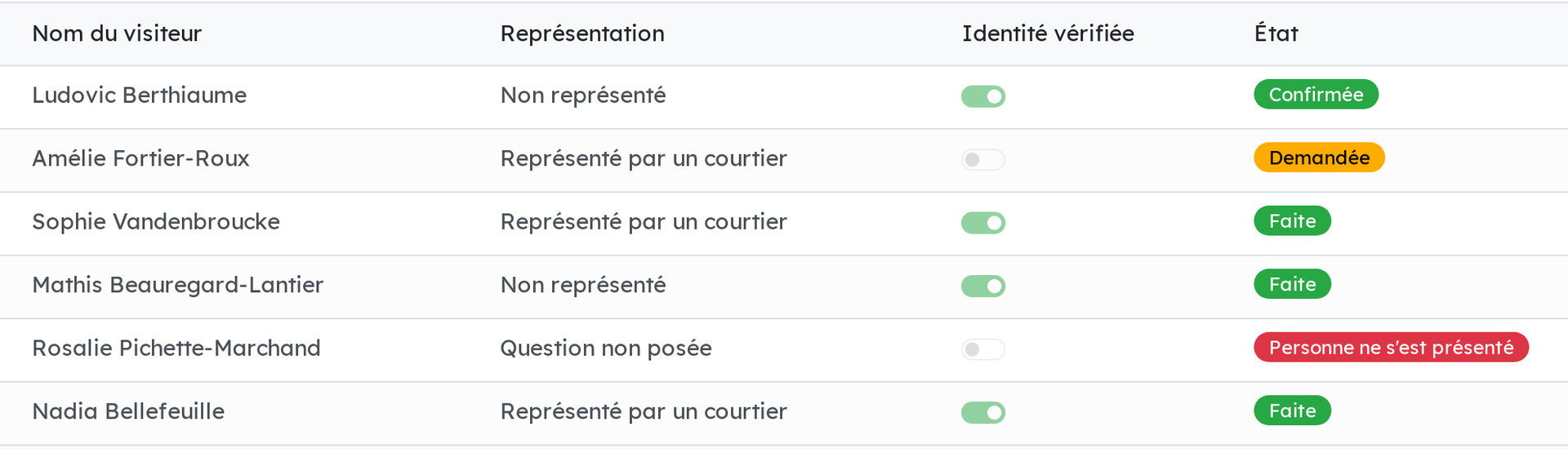
The broker's side: the visit register. Each row keeps the answer on representation, the identity check, and what happened. Interface in French.
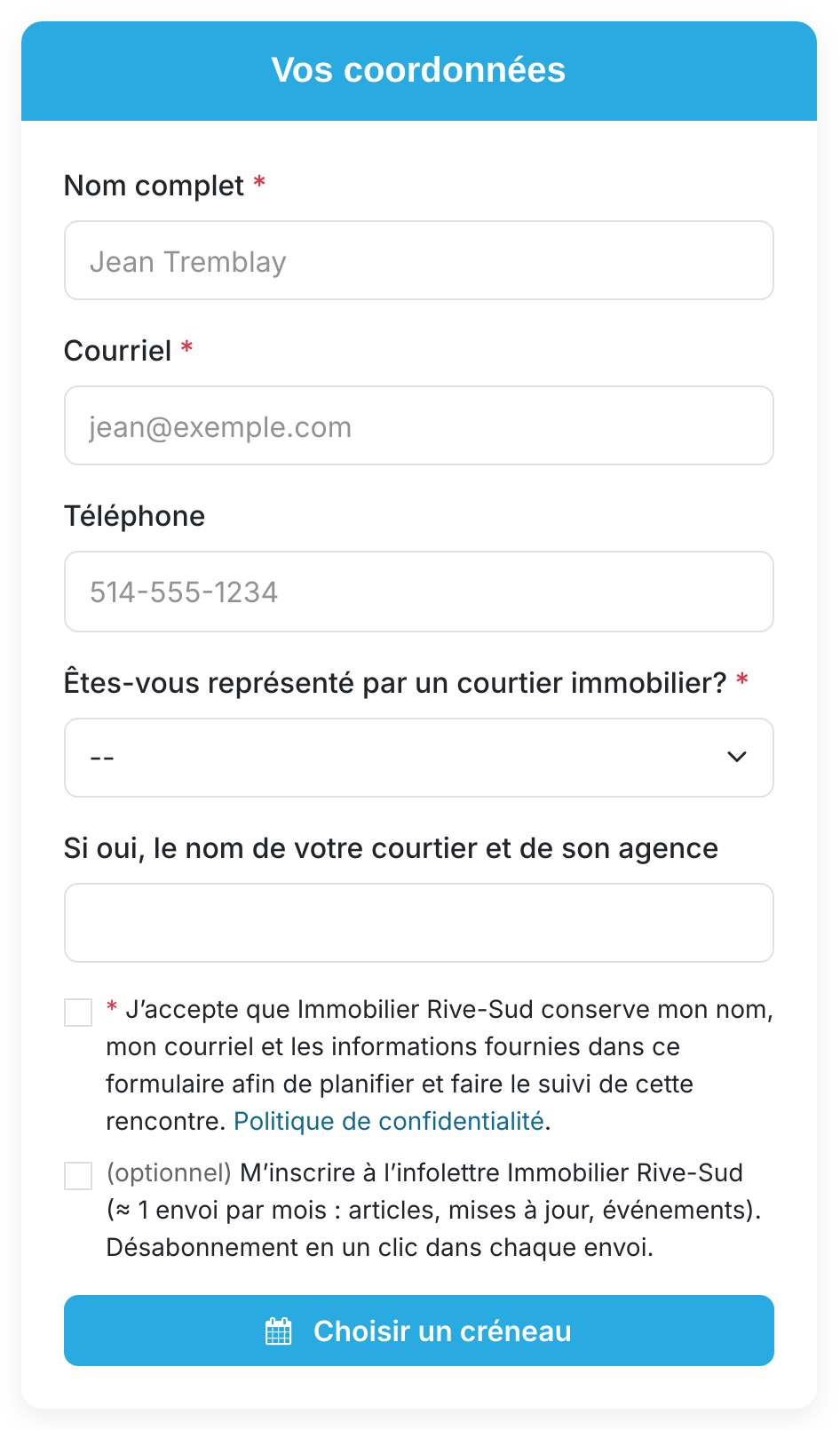
The visitor's side: the representation question comes before a time slot is even chosen. Interface in French.
Our preference goes to open source tools, hosted in Québec, on your own data. That is not a matter of principle: a register of visits holds information about people who signed nothing with a foreign supplier, and the regulation asks you to limit access to authorized people, for the information necessary to their activities only. That question can only be answered if you know where the data lives and who can read it.
Let's talk about your showings if this sounds familiar.
Sources
- OACIQ, Should the seller's broker attend an open house?: the broker's presence, checking visitors' identity and the register of visits.
- OACIQ, What are the duties of the seller's broker when I request to visit the property?: the representation question, the efficient cause of the sale and the APCIQ's role in remuneration disputes.
- OACIQ, Identity verification and protection of personal information: who must be identified, with which documents, and why no photocopy is kept.
- OACIQ, Guideline on preventing money laundering: identity verification: the broker leaves the choice of document to the party and cannot require a specific one.
- Regulation respecting brokerage requirements, professional conduct of brokers and advertising: the duty to inform an unrepresented party and to disclose that you hold a licence.
- Regulation respecting records, books and registers, trust accounting and inspection of brokers and agencies: the six mandatory registers, what a record contains, falsification, access control, the six years and destruction.
- Tribunal administratif du logement, Access to the dwelling and visiting rights: verbal or written notice, permitted hours, the lessor's presence, locks and the Tribunal's powers.
- Civil Code of Québec, article 1931: the 24-hour notice before an inspection, work, or a visit by a prospective acquirer.
- Civil Code of Québec, article 1932: the tenant's right to refuse before 9 a.m. or after 9 p.m., and to refuse if the lessor cannot be present.
- Act respecting the protection of personal information in the private sector, section 5: collect only the information necessary for the purposes determined before collecting it.
- Act respecting the protection of personal information in the private sector, section 23: destroy or anonymize once the purposes are achieved, subject to any preservation period provided for by an Act.
- Toronto Regional Real Estate Board, BrokerBay frequently asked questions (2021): the showing tool included in membership dues, and what is excluded from it.
- BrokerBay, seller features: accept, deny, cancel or suggest another time from an email or a text.
- ShowingTime, listing setup: the minimum lead time before a showing, set for each listing.
- Supra, acquisition of BrokerBay: BrokerBay folded into Supra, the lockbox manufacturer, in 2021.
- SentriLock, APIs: some thirty integrated vendors, each authorized by the board and the managing broker.
- Domodo, App Store listing: send, accept or decline a showing request between brokers and propose a new time, synced with Centris Zone.
- Immocontact for real estate brokers: showing management for Québec brokers since 1999.
- Grouillez-vous immo (in French): booking synced with the broker's calendar, with confirmation and reminders by text or email.