TL;DR: Law 25 doesn't ask for a binder of policies, it asks for living registries: a designated officer whose details are published, consents that carry their own proof, a retention schedule, documented destructions, an incident register, and requests handled within the deadlines. Our Privacy module sets all of that up inside your Odoo, where your contacts and documents already live, with automatic reminders so nothing freezes over.
In this article
- Who this is for, and who it isn't for: three closed questions, and two of them rule you out before any configuration begins.
- What the law actually requires: manifest, free and informed consent per purpose, destruction as soon as the purposes are fulfilled.
- What the Commission can ask to see: seven obligations that leave a trail, with the section of the act and the expected proof.
- The module, registry by registry: consents, notices sealed with a fingerprint, per-channel preferences, retention schedule, tamper-proof destructions.
- The deadlines that aren't negotiable: thirty days to answer an access request, and silence counts as a refusal.
- What a dormant registry costs: up to 10 million or 2% of worldwide turnover, and a 1,000 dollar punitive floor.
- What about OneTrust?: no published price and a quote on request, and rivals' free tiers cover only the banner.
- What the tool won't do for you: the process, the judgment calls on assessments and access governance stay human work.
- Where to start, in order: the officer and the public page first, the retention schedule next, destructions last.
September 2023: your personal information governance plan is filed, the privacy officer is appointed, the policies are signed. November 2026: open the consent registry and look at the date of the last entry. For many Quebec SMBs, it goes back... to September 2023. Compliance got done, then it stopped.
Who this is for, and who it isn't for
Three questions, and the last two are the ones that rule people out.
Does your personal information already live in Odoo? Clients, employees, volunteers, members. If your HR files sit on a file share, your invoicing in another application and your mailing lists with an American vendor, a registry inside Odoo will cover part of your reality, not all of it. Still useful, but worth knowing beforehand.
Has the governance work been done at least once? Officer appointed, inventory of what you hold, policies written, retention periods decided. If none of that exists, the tool arrives too early: what you need first is advisory work. Our review of Law 25 four years on covers where to start.
Does anyone at your organization own these registries? Not the title, the mandate: time on the calendar and the authority to say no to a collection. A registry with no owner gets filled in for about two months.
If you answered no to the second or third question, read the review article instead and come back here afterwards. The rest of this one assumes the governance work exists and is trying to last.
What the law actually requires
Every provision of Law 25 has been in force since September 2024, including the right to portability. And the law's mechanics are continuous, not one-time: every consent must be demonstrable, every document category has a retention period to respect, every destruction must be provable, and every access or erasure request has processing deadlines.
The law is also more precise than people remember. Consent must be manifest, free, informed and given for specific purposes, requested for each of those purposes in clear and simple language, and presented separately from everything else when it is in writing. It is valid only for as long as the purposes require. Consent obtained any other way has no effect, which means a pre-ticked box in a form is worth nothing, signature or not.
Retention works the same way. Once the purposes are fulfilled, the information must be destroyed or anonymized, subject to a retention period set by another statute. Anonymization is not a nickname in a column: the law requires that it no longer be reasonably possible, irreversibly, to identify the person, according to criteria set by regulation.
In other words, the deliverable isn't the binder: it's the trail, year after year. The same finding keeps coming back when you look at a two-year-old compliance file: the policies exist, the registries don't keep up. The problem isn't bad faith, it's that the registry lives in a separate Word document, far from operations.
What the Commission can ask to see
Seven obligations leave a verifiable trail. This is the list to keep at hand, because this is what you will be asked to produce, not your intentions.
| What the law requires | Where it is written | The expected proof |
|---|---|---|
| A privacy officer whose title and contact details are published on your website | s. 3.1 | The public page, and the written delegation if it isn't the person with the highest authority |
| Governance policies covering retention, destruction, staff roles and complaint handling | s. 3.2 | The policies approved by the officer, with their date |
| A privacy impact assessment before any new system, and before any transfer of information outside Quebec | s. 3.3 and 17 | The written assessment, and the written agreement for the transfer outside Quebec |
| A register of confidentiality incidents, a copy of which goes to the Commission on request | s. 3.8 | The register itself, kept up to date |
| Consent that is manifest, free, informed, and requested for each purpose | s. 14 | Which version of the notice was presented, on what date, by what means |
| Destruction or anonymization as soon as the purposes are fulfilled | s. 23 | The date, the method, and who authorized it |
| A written answer to an access or rectification request no later than 30 days after receipt | s. 32 | The date of receipt and the date of the answer |
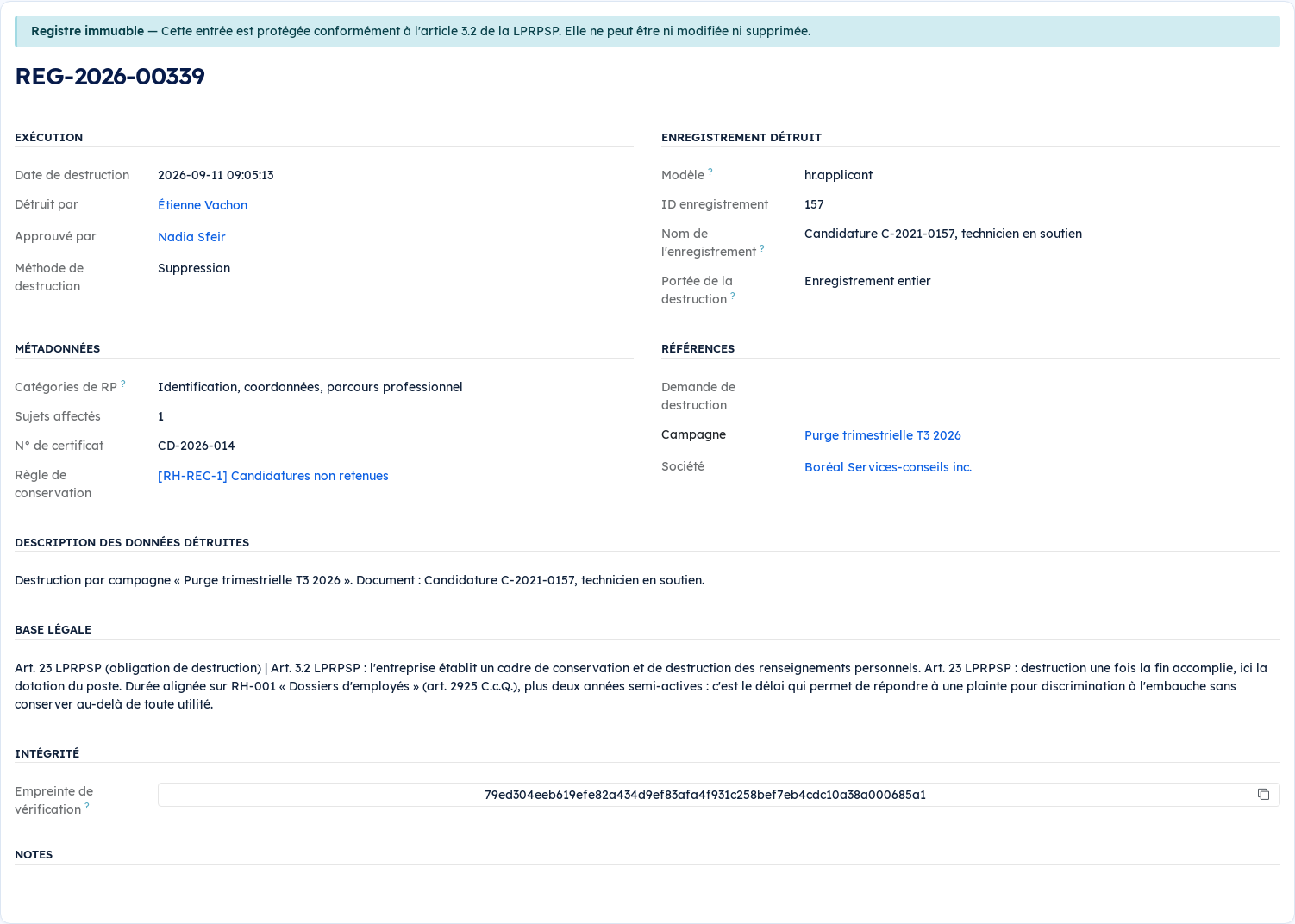
Screenshots taken from the public Symbifox demonstration, on a fictitious company.
The module, registry by registry
Consents. Every consent, newsletter, meeting recording, third-party sharing, client testimonial, gets requested, granted, refused or withdrawn with a complete time-stamped trail. The contact responds themselves through a personalized link that needs no account, and a PDF certificate documents the proof. Expiring consents trigger automatic reminders, and the case of minors under 14 is handled, with the link to the legal representative.
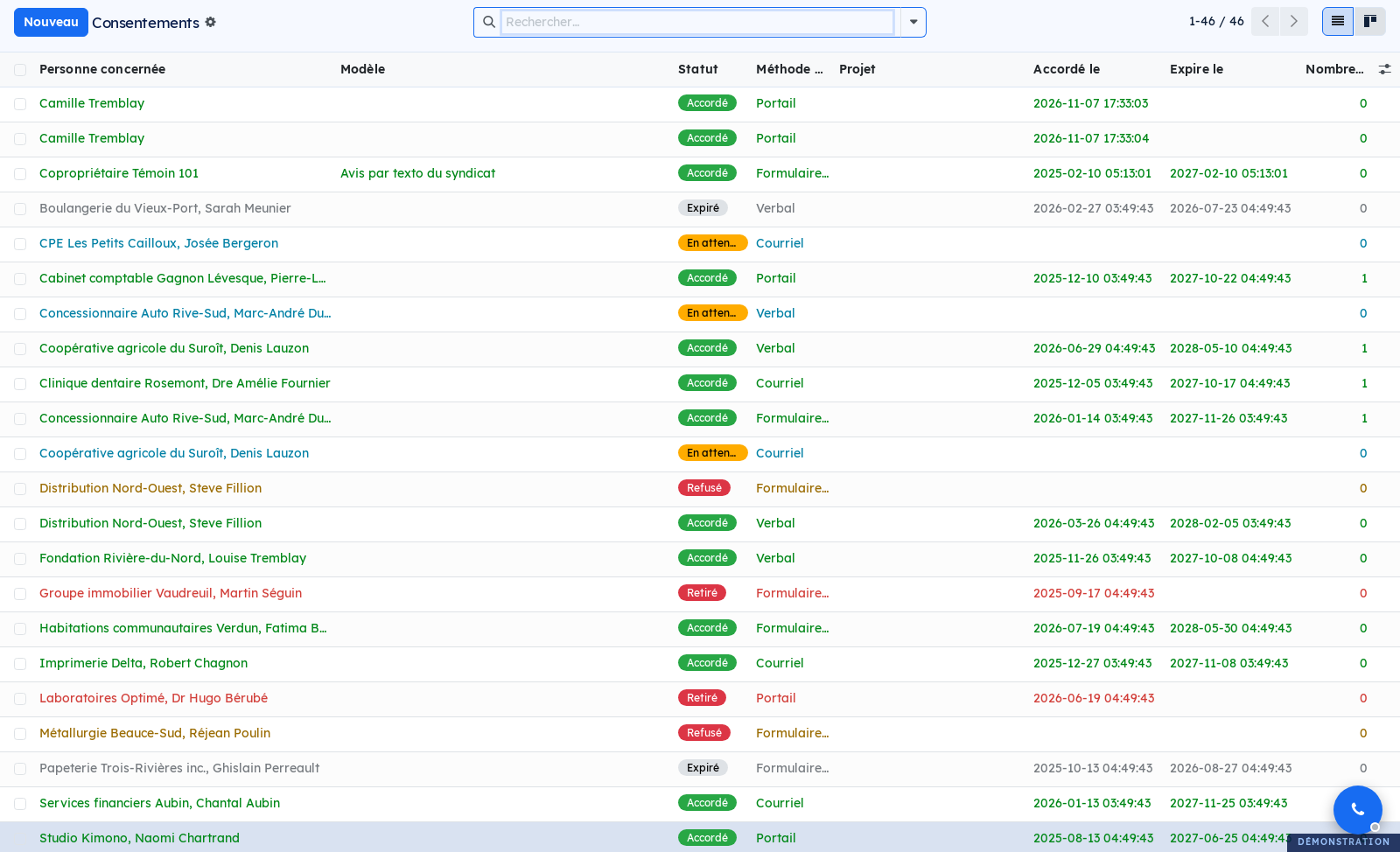
The notices, and the exact version that was shown. This is the detail that separates a registry from a list. Consent texts are versioned and sealed with a digital fingerprint: a version already in use can no longer be modified, and the registry remembers which one was presented to that person, on that day. Two years later, when someone asks what they agreed to, the answer doesn't depend on anyone's memory.
The evidence. A consent collected online keeps its technical markers. A consent obtained verbally keeps the note of who collected it and when. A signed consent keeps its document. All three routes sit in the same registry, and each one states how it was obtained.
Communication preferences. By channel: service email, marketing email, phone, text message. With a "do not contact" switch that cuts everything, the preferred language, and the reason for the opt-out. That's what prevents the one email too many, the one that turns an annoyed client into a complaint.
The designated officer, and the public page. The organization record holds who is in charge, the address where notices must be sent, and where those details are published. The address is never guessed: a legal notice that would go out without it gets refused by the system rather than sent at random.
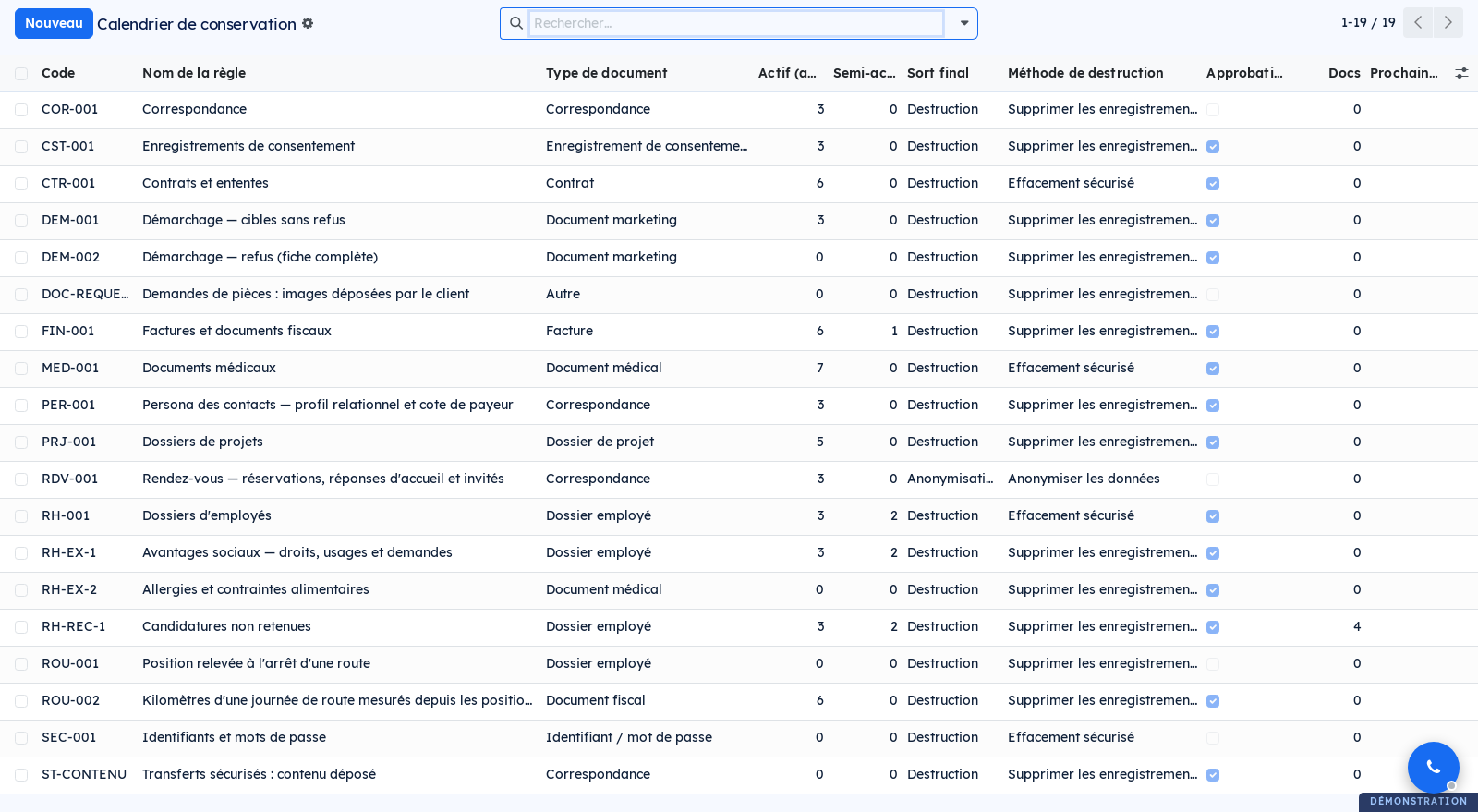
Retention and destruction. A retention schedule, with a mandatory legal basis per category, contracts, invoices, employee files, determines what must be destroyed and when, and what gets anonymized, archived or transferred instead. Destruction campaigns sweep expired documents, go through human review, then execute. Every destruction is written to a tamper-proof registry: once recorded, the entry can no longer be modified or deleted, and a destruction certificate prints out when needed. The entry also names what actually went: when the method anonymizes instead of deleting, the registry lists the fields that were cleared and states that the record survives, minus those. An anonymization that would remove nothing gets refused rather than certified.
The right to erasure. When someone asks for their information to disappear, the request is handled from their record, with the same traceability.
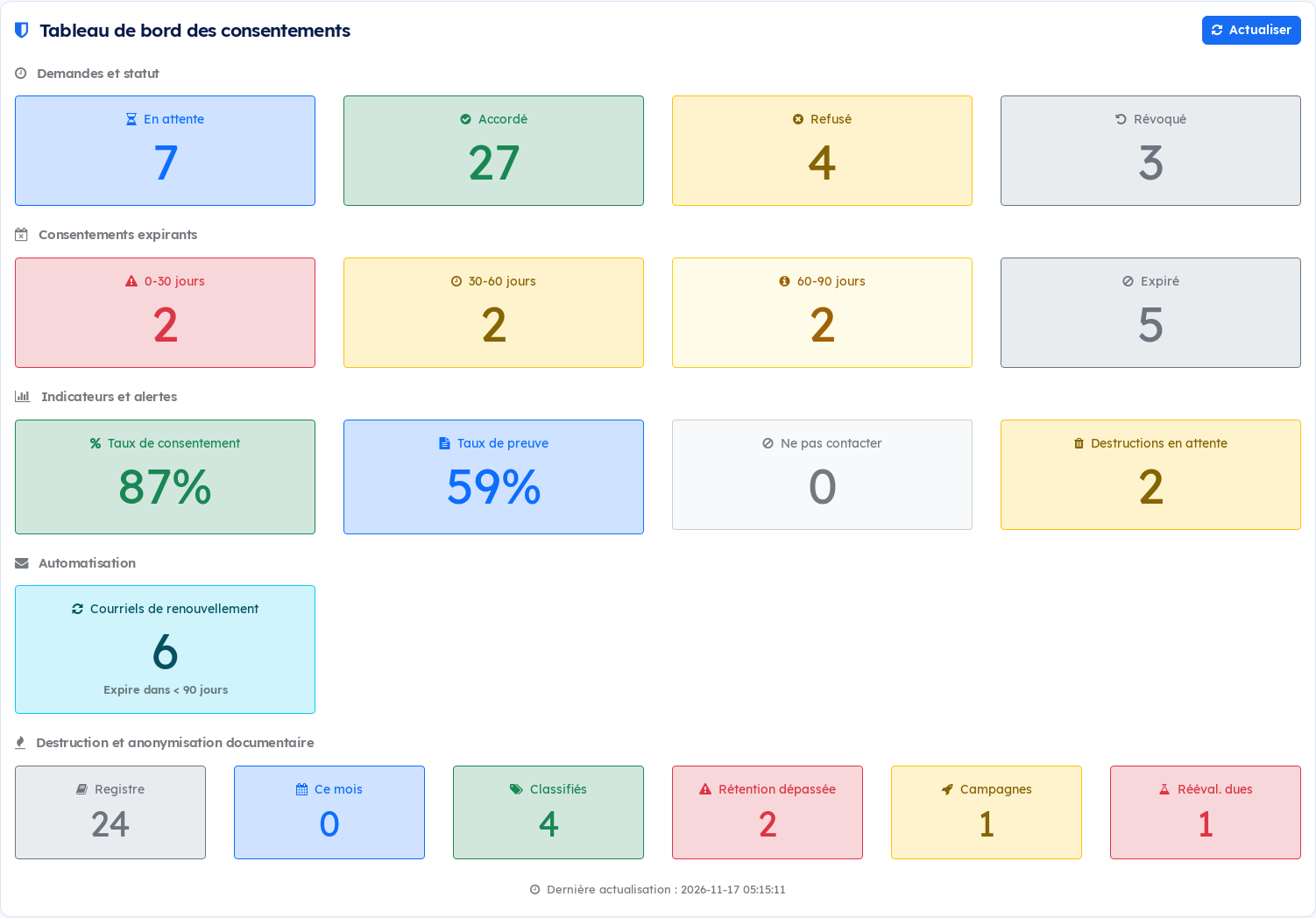
The dashboard. Consents granted and refused, upcoming expirations, pending destructions: the officer sees the real state at a glance, instead of reconstructing it once a year.
The deadlines that aren't negotiable
Three clocks are running, and none of them stops because the person in charge is on vacation.
An access or rectification request must receive a written answer with diligence, and no later than 30 days after it was received. The text is unambiguous about what silence means: failing to answer within that period, the business is deemed to have refused the request. An email lost in a shared mailbox therefore becomes a refusal, with the recourse that comes with it.
A confidentiality incident that presents a risk of serious injury must be reported to the Commission d'accès à l'information with diligence, and the people concerned must be notified. Not at the next management meeting. And whatever the scale of the incident, it has to be entered in the register, because it's the complete register that can be requested.
Consent, finally, is only valid for as long as the purposes it was requested for. A 2022 consent for a newsletter that has changed character twice since isn't a consent: it's a date in a spreadsheet. Expiry reminders exist for exactly that.
What a dormant registry costs
The numbers in Law 25 are spectacular, and deliberately so. The administrative monetary penalty can reach 10 million dollars or 2% of worldwide turnover for the preceding fiscal year, whichever is higher. On the penal side, the fine runs from 15,000 dollars to 25 million or 4% of worldwide turnover. And when an unlawful infringement is intentional or results from gross negligence, the court must award punitive damages of at least 1,000 dollars, on top of the actual injury.
One honest caveat: nobody should read those figures as the bill waiting for a fifteen-person business. Penalties of that calibre target serious, repeated failures. The realistic risk at that size is more mundane, and far more frequent: the evidence file to reconstruct in a hurry on a Friday afternoon, the institutional client who asks for your policies before renewing, the insurer who asks the question on the form. On that last point, what an incident with no insurance really costs gives the orders of magnitude.
The 1,000 dollar floor on punitive damages still deserves a second look. The recourse belongs to each person harmed, which changes the arithmetic when a single breach touches a thousand of them at once.
What about OneTrust?
The commercial reference in this category is OneTrust. It's a serious product, built for large organizations. Its price isn't public: the pricing page carries no figures and asks for a call to get a quote based on the size of your team, with pricing driven by usage meters. The amounts circulating in competitors' comparison posts don't agree with each other, and none of them come from the vendor.
One thing deserves saying because it argues against us: several tools in this family have a free tier. Cookiebot, for one, publishes one, capped at a single domain of 50 subpages. It covers the cookie banner on a website, with a limit on pages. That's useful, and it doesn't touch the registries this article is about: not your employees' consents, not your retention schedule, not your destructions. A free banner answers none of the seven obligations in the table above.
Our position is simpler: your contacts, documents and employees are already in your Odoo. The registry about them just has to live in the same place, at home. It's consistent with what we think about the jurisdictions where data sleeps, and with a question people rarely put to a compliance vendor: which country does the registry proving your compliance live in, and under which law?
What the tool won't do for you
A module doesn't make anyone compliant. The process, appointing the officer, mapping the information, writing the policies, training the team, remains advisory work, and that's normal. The tool takes over afterwards, so the process doesn't die in a binder.
The privacy impact assessment, in particular, stays a matter of judgment. The module keeps the assessment and attaches it to the project, it doesn't decide for you whether the risk is proportionate. Same for anonymization: the criteria are in the regulation, and someone has to judge that they've been met.
Two cases go further than judgment: the module refuses outright. A contact record carrying issued invoices will not anonymize on a click, because those documents are kept and would stay in the name of an "Anonymized person". Neither will a record carrying a user account, because clearing the record would rename the account without removing a single access right. In both cases the request logs the refusal and the decision goes back to a person.
It also requires a team reflex: registries fill up through day-to-day operations, not by magic. Asking for consent at collection time, filing documents in the right categories, it's all learnable in one training session, but it does have to be learned.
And a technical caveat: the destruction registry is tamper-proof at the application level, but a database administrator keeps, by definition, technical access to the data. IT access governance therefore remains a piece of your compliance, not an option, and the arrival and departure checklist covers the part of it that gets forgotten most often.
One last point, for businesses with clients in Europe or elsewhere in Canada: the same engine carries the GDPR, the UK GDPR, the Canadian federal act and the New Zealand act, each with its own deadlines and its own title for the officer. If your obligations overlap, the registries don't have to be kept twice. Our notes on NIS2 and European standards explain when that overlap begins.
The Privacy module is part of Symbifox, our all-inclusive ERP, and of its Law 25 suite, which we deploy with the support that goes with it: process, training, and registries that actually run.
Where to start, in order
The order matters, because each step makes the next one easier.
The officer and the public page. It's the simplest obligation to settle and the most visible from outside. An hour of work, and it shows on your website.
The retention schedule. Category by category, with the legal basis that justifies each period. It's the most thankless step and the one that unlocks everything else, because it finally says what has to go and when.
Consents, starting with the two most urgent. The newsletter and meeting recordings. Those are the ones requested most often and proved worst.
The incident register, before you need it. A register created on the day of the incident starts with a line written under pressure. One that already existed starts with a procedure.
Destructions, last. Once the schedule holds and the first deadlines arrive, the first campaign runs with human review and without rushing.
If your consent registry hasn't moved since your governance plan was filed, let's talk about your registries.
Sources
- Act respecting the protection of personal information in the private sector (LegisQuébec): the current text, including sections 3.1 (published officer), 3.2 (policies), 3.3 and 17 (assessments), 3.5 and 3.8 (incidents and register), 14 (consent), 23 (destruction and anonymization), 27 (access and portability), 32 (the 30-day deadline), 90.12 and 91 (penalties), 93.1 (punitive damages)
- Commission d'accès à l'information: the final phase of Law 25 (portability) came into force on September 22, 2024
- OneTrust: a pricing page with no figures, quote on request, pricing driven by usage meters (checked on November 15, 2026)
- Cookiebot: a free tier capped at one domain of 50 subpages, with paid plans starting at 7 euros a month (checked on November 15, 2026)
- The
privacy_consentmodule, a Blue Fox exclusive: the source is published on our GitHub repository and you host it yourself, and its card is on our modules page